CONDITION ASSESSMENT METHODOLOGY
Written by : Siswanto, Power Generation Engineer
Failure of insulation is considered to be major factor in electrical rotating machine. Aging of insulation generally follows a chemical rate degradation curve and in addition is severely affected by the number of stops and starts, the frequency of stops and starts as well as large load variations.
Wound stator / rotor windings operating in utility and industrial plants have failed when exposed to the fast rise-time voltage surges coming from unbalance load, drives, breaker, lightning impulse, etc.
Machine failure is due to a combination of bad luck in winding insulation process and material quality show that these surges create partial discharges (also called corona) and these discharges may eventually destroy the turn-to-turn and/or phase-to-phase insulation, resulting in premature machine failure.
During operation, large synchronous generators are continuously subjected to electrical, mechanical, thermal, and environmental stresses. These stresses act and interact in complex ways to degrade the machine’s components and reduce its useful life. Deterioration of the stator winding insulation is a leading factor for determining the serviceability of generators. Unexpected stator winding failure can result in forced outages and costly emergency repairs. Operation and maintenance history may provide a useful indication of stator condition.
INSPECTION
Generator to be evaluated by 2 conditions:
- Routine inspection (Tier-1)
- Non routine inspection (Tier-2)
Routine inspection is categorized routing inspection during machine shutdown where the rotor in place, inspection and evaluation including:
- Evaluate the historical of machine operation and maintenance
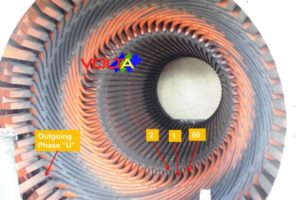
- Physical / Visual inspection
- Measurement of Insulation Resistance (IR) and Polarization Index (PI)
- Measurement of Copper DC Resistance
Non routine inspection is categorized major or semi major inspection during machine shutdown, with rotor in place or rotor outside, inspection including:
- Dissipation factor (tangent delta) test, can be performed during rotor in place or outside
- Off line partial discharge test, can be performed during rotor in place or outside using capacitive coupler, if top cover of machine removal PD probe can be used to inspect the PD level at endwinding region, both test PD with C coupler or PD probe is require external HV supply injected to the stator winding.
- Endoscopic inspection can be performed if the top cover are removal
- PDCA (Polarization Depolarization Current Analysis) as option
- Hipot DC or AC
- If rotor removal from the stator bore, following test can be done for the stator:
- EL CID test
- SWA : Stator wedge analysis
- Capacitance mapping
- Contact resistance / contact coefficient
- Stator core tightness
- Endwinding natural frequency / bump test
- Blackout / corona light
- Rotor can be test
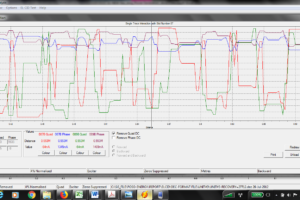
- RSO (Recurrent / repetitive Surge Oscillosgraph), this test can be performing during rotor in place or outside, if rotor slipring RSO can be done during rotor spin without excitation.
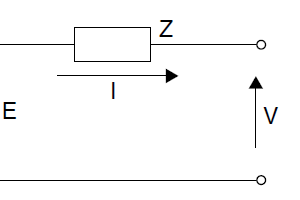
- Static AC impedance when rotor standstill or dynamic AC impedance by turning the rotor from lower speed to full speed normally with increment 10% x full speed.
Generator condition to be analyzed by scoring index method (ref: USBR-Generator Condition Assessment Appendix).
The generator condition to be scoring based on the routine and non-routine inspection and testing result to determine the recommended of action.
| STATOR GENERATOR CONDITION INDEX | GENERATOR SUGGESTION OF ACTION | |
| ≥ 7.0 and ≤ 10 (Good) | Continue O & M without restriction. Repeat condition assessment as needed. | |
| ≥ 3.0 and < 7 (Fair) | Continue operation but re-evaluate O & M practices Consider using appropriate Tier 2 (non-routine) test. Repeat condition assessment process as needed. | |
| ≥ 0 and < 3.0 (Poor) | Immediate evaluation including additional Tier 2 (non-routine) testing.. Adjust O & M as prudent. Begin replacement/rehabilitation process | |